
A fully compliant restaurant background music program requires blanket public-performance licenses from all five U.S. PROs (ASCAP, BMI, SESAC, GMR, and ALLTRACK), written documentation of that coverage, and a subscription-managed audio service built for commercial use. Consumer streaming accounts from Spotify, Apple Music, or YouTube do not qualify. Their Terms of Service explicitly prohibit commercial playback, and playing music without proper licensing can expose your business to statutory penalties that industry reporting notes can be substantial for each infringement. Voraistudio provides a subscription-managed service that handles curated music, promotional messaging, and PRO documentation in one package.
Table of Contents
- What does restaurant background music compliance actually require?
- How subscription background music services work, and where gaps appear
- Questions to ask any in-store audio provider before you sign
- How to use your audio system for promotions without creating new legal risk
- Red flags that signal a non-compliant or risky provider
- Voraistudio handles the compliance work so you don’t have to
- Key Takeaways
- Why compliance and curation belong together
- Useful sources and further reading
What does restaurant background music compliance actually require?
The legal foundation sits in 17 U.S. Code §106, which grants copyright owners the exclusive right to publicly perform their works. The statute defines “perform” and “public” broadly: any audible playback in a space open to the public, or transmitted to one, qualifies. That covers:
- Background music through speakers (recorded or streamed)
- Live bands and DJ sets
- Karaoke systems
- Televisions playing music videos or sports with music
- Any device transmitting music to customers
SESAC describes a blanket license as the standard compliance method: pay an annual fee and access the PRO’s entire catalog without tracking individual songs. The five U.S. PROs each represent different songwriter and publisher catalogs, so a license from one does not cover the others.
The five PROs every U.S. restaurant operator must know:
- ASCAP (American Society of Composers, Authors and Publishers): the largest U.S. PRO by catalog size; publishes multiple rate schedules based on venue type, capacity, and whether music is live or recorded
- BMI (Broadcast Music, Inc.): covers a large catalog of pop, country, and R&B
- SESAC: a smaller but selective PRO whose catalog includes major contemporary artists
- GMR (Global Music Rights): represents a focused roster of high-profile songwriters
- ALLTRACK: the newest of the five, growing its catalog steadily
Industry guidance from the NMRA confirms that most restaurants need licenses from multiple PROs, not just one. ASCAP’s exemptions for radio and TV playback in food service establishments are narrow and tied to square footage thresholds. Most restaurant uses require a direct license.
Compliance reality: A single blanket license covers one PRO’s catalog. A restaurant playing a broad mix of music almost certainly needs coverage from all five.
How subscription background music services work, and where gaps appear
| Feature | Consumer Streaming (Spotify, Apple Music) | Basic B2B Music Service | Fully Managed Commercial Audio |
|---|---|---|---|
| Commercial license | No | Partial (varies by PRO) | Yes, documented |
| PRO coverage | None | 1–3 PROs typically | All 5 PROs (verify per vendor) |
| Curated playlists | Generic | Limited | Custom by brand/daypart |
| Promotional audio insertion | No | Rarely | Yes |
| Certificate of coverage | No | Sometimes | Yes, with license IDs |
| Multi-location management | No | Limited | Yes |
| Audit assistance | No | Rarely | Yes |
A fully managed commercial audio service bundles curated playlists, cloud streaming, zone scheduling, and documented PRO coverage into a single subscription. The key differentiator from a basic B2B service is documentation: a written certificate of coverage with license IDs you can verify against the issuing PRO’s records.
What third-party services rarely cover, even the legitimate ones:
- Live bands and DJ sets (those require separate PRO licenses in the venue’s name)
- Karaoke (requires a separate synchronization or karaoke license)
- Televisions playing broadcast or cable content (covered by the broadcaster’s license, not yours)
- Any consumer app a staff member connects to the sound system
Pro Tip: Request the certificate of coverage before signing any contract. Then call or email the PRO directly to confirm the certificate number is active and covers your venue type. A vendor who hesitates on this step is a vendor worth walking away from.
Modern Restaurant Management notes that B2B services can eliminate grey areas, but only when operators verify the certificate against PRO records rather than taking the vendor’s word for it.
Questions to ask any in-store audio provider before you sign
Legal verification checklist:
- Which of the five PROs are covered (ASCAP, BMI, SESAC, GMR, ALLTRACK)? Get the answer in writing.
- Will you provide license IDs and certificates of coverage for each PRO?
- Does coverage extend to live events, DJ nights, or karaoke at my venue?
- Does coverage extend to televisions or AV systems?
- Will you assist if a PRO contacts my business for an audit?
Operational checklist:
- How many audio zones does the service support?
- Is any hardware required, or is it cloud-only?
- How often are playlists updated, and who controls the schedule?
- Can I insert custom announcements or promotional audio?
- What are the SLA and support hours?
- How does multi-location management work for franchise operators?
Contract terms to insist on:
- Indemnity language that protects your business if a licensing gap is discovered
- A clear scope of PRO coverage written into the contract (not just a verbal claim)
- Separate line items for licensing fees versus service and production fees
- Proof delivery timelines (when you receive certificates after signing)
- Renewal terms and notice periods
Sample questions to ask vendors directly:
- “Can you send me the certificate of coverage for each PRO before I sign?”
- “Which PROs are NOT included in your license?”
- “What happens to my coverage if I add a live music night?”
- “How do I document compliance for a PRO audit?”
Pro Tip: Ask for a sample proof packet from a current client (with identifying details redacted). A vendor with nothing to hide will have one ready.
How to use your audio system for promotions without creating new legal risk
Promotional messaging and in-store announcements are where many operators unknowingly create a second compliance problem. The safest approach:
- Produce all promotional audio using original music or music your provider has cleared for commercial ad use
- Never sample a copyrighted song in a promotional spot without a separate synchronization license
- Schedule promotional messages during natural breaks (between songs, not over them)
- Confirm with your provider whether ad content is covered under their existing licenses or requires additional clearance
Most fully managed services handle ad insertion through a scheduling dashboard. Your provider should confirm in writing whether the production music used in your spots is cleared for commercial broadcast in your venue. If they cannot confirm this, produce spots with original or royalty-free music instead.
For tracking effectiveness, tie promotional audio to measurable actions: a redemption code mentioned in the spot, a limited-time item tracked at the POS, or a QR code displayed near the speaker zone. Play counts alone tell you nothing about whether the promotion worked.
Pro Tip: When scripting a menu promotion, keep the spot under 20 seconds and mention the offer once. Longer spots with repeated music beds are more likely to require additional clearances, and they irritate guests.
Red flags that signal a non-compliant or risky provider
The most common operator mistake is also the most avoidable: connecting a personal Spotify, Apple Music, or YouTube account to the restaurant’s sound system. Every major streaming platform’s Terms of Service prohibits commercial use, and “we didn’t know” is not a defense in a PRO enforcement action.
Other mistakes that create real exposure:
- Assuming one PRO license covers all music in your venue
- Accepting a vendor’s verbal claim of “we’re fully licensed” without written proof
- Failing to get separate coverage for live events, karaoke nights, or DJ sets
- Letting staff use personal devices connected to the sound system
Red flags from providers:
- Refusal or delay in providing license IDs or certificates of coverage
- Contract language that says “licensed music” without specifying which PROs
- Bundled pricing with no breakdown between licensing and service fees
- No mention of audit assistance or indemnity language
Document everything. Keep invoices, certificates of coverage, email confirmations of PRO scope, and any written assurances from your provider in a dedicated compliance folder. If a PRO contacts your business, that folder is your first line of defense. Verbal assurances from a vendor mean nothing in an audit.
If you discover your current setup is non-compliant, act immediately: stop playback from any unlicensed source, contact each PRO directly to request temporary coverage while you formalize licensing, and get written confirmation of your new coverage before resuming.
Voraistudio handles the compliance work so you don’t have to
Switching from a patchwork of consumer apps and verbal vendor assurances to a fully documented audio program is exactly the kind of operational lift most restaurant operators want handled for them, not managed manually.
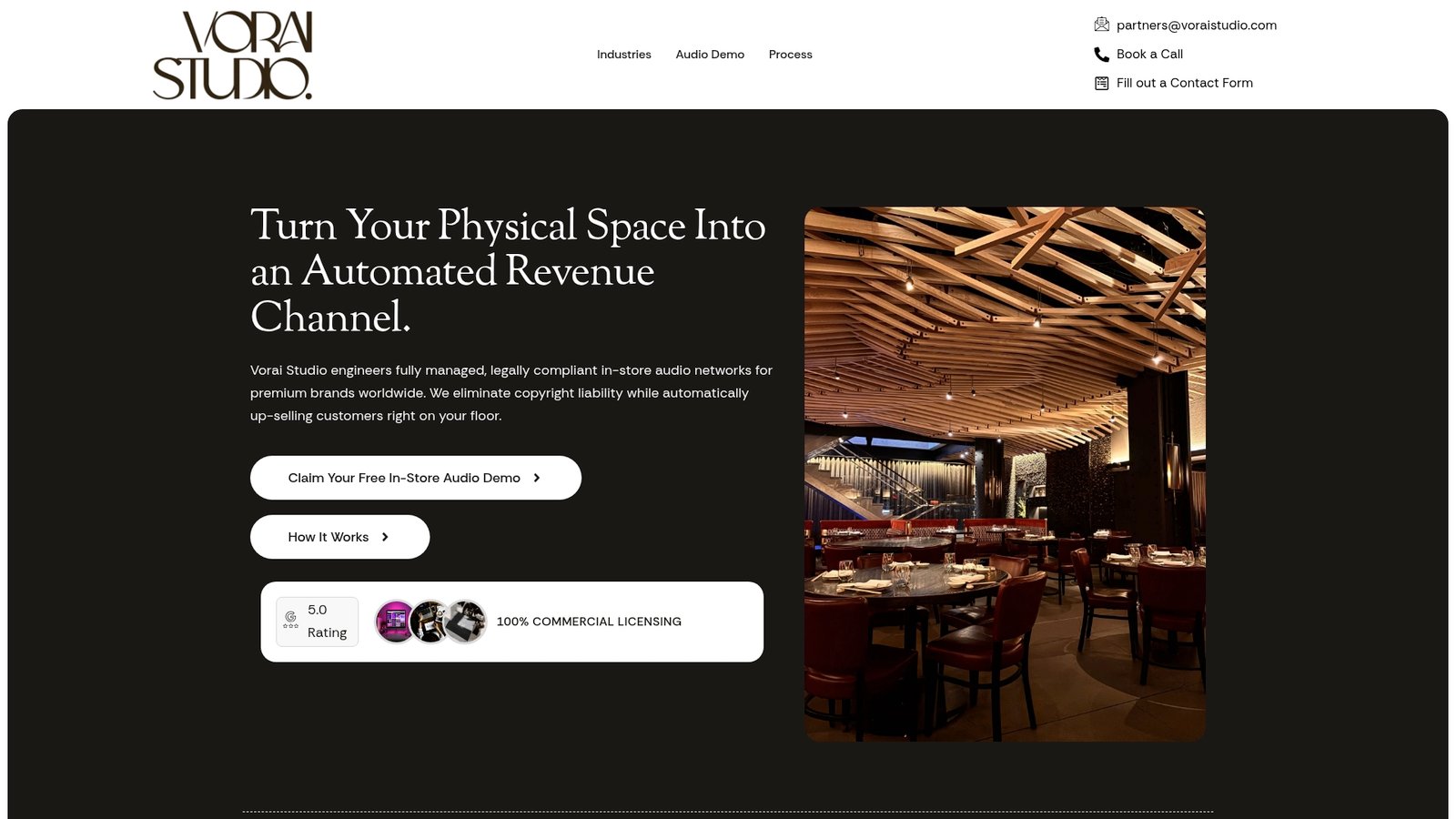
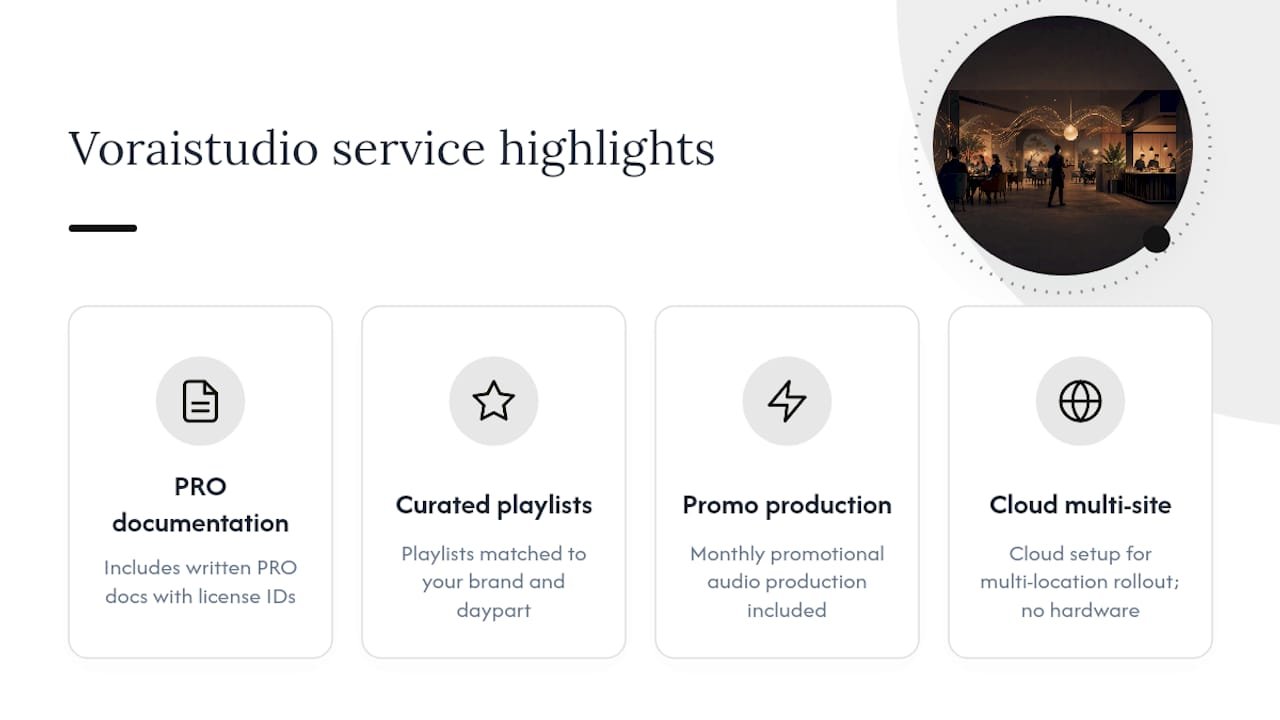
Voraistudio provides fully managed, commercially licensed in-store audio networks built specifically for restaurants, franchise groups, and multi-location operators. Every subscription includes written PRO documentation with license IDs, custom-curated playlists matched to your brand and daypart, and monthly promotional audio production. There is no hardware to source separately: the service runs on a cloud-based setup that works across multiple locations from a single account. When a PRO inquiry arrives, Voraistudio’s documentation is already in your file.
For franchise operators managing dozens of locations, the multi-location rollout capability means consistent sound ambiance and compliant coverage across every site, not just the flagship. Request a proof packet or schedule a discovery call at voraistudio.com to see the license documentation before you commit to anything.
Key Takeaways
A compliant restaurant audio program requires blanket licenses from all five U.S. PROs, written certificates of coverage, and a subscription service that separates licensing fees from production costs.
| Point | Details |
|---|---|
| Verify all five PROs | Confirm ASCAP, BMI, SESAC, GMR, and ALLTRACK coverage in writing before signing any contract. |
| Request certificates, not promises | Ask for license IDs and verify them directly with each PRO; verbal assurances carry no weight in an audit. |
| Separate fees in writing | Insist on line-item pricing that distinguishes PRO licensing fees from subscription and production costs. |
| Consumer streaming is never compliant | Spotify, Apple Music, and YouTube accounts prohibit commercial use in their Terms of Service. |
| Voraistudio covers the full picture | Voraistudio’s managed service includes PRO documentation, curated playlists, promotional audio, and multi-location rollout support. |
Why compliance and curation belong together
The conversation about restaurant background music tends to split into two camps: the legal side (PROs, licenses, penalties) and the experiential side (the right tempo for a Friday dinner rush, the playlist that keeps a brunch crowd comfortable). Treating them as separate problems is where operators get into trouble.
A venue that has its PRO paperwork in order but plays algorithmically generated playlists with no brand logic is leaving money on the table. A venue with a beautifully curated sound program running on a personal Spotify account is one PRO audit away from a serious problem. The managed service model works precisely because it handles both at once: the legal infrastructure and the audio craft are built into the same subscription.
What most operators underestimate is how much the audio environment shapes purchase behavior. Tempo, genre, and volume affect dwell time and order size in ways that are well-documented in hospitality research. A managed service that combines legal coverage with intentional curation is not a luxury item; it is a revenue tool with a compliance wrapper.
Useful sources and further reading
For operators who want to verify licensing terms directly or review the legal text, these are the primary sources:
- SESAC | Why You Need a Public Performance License
- Is your business playing music in public spaces legally? | Nixon Peabody
- 17 U.S. Code § 106 — Exclusive rights in copyrighted works
- Music licensing for restaurants — NMRA
- What Restaurant Operators Need to Know About Music Licensing | Modern Restaurant Management
- Restaurants, bars consider turning off music as licensing fees skyrocket — Los Angeles Times
- ASCAP Music Licensing FAQs
This article is general information, not legal advice. Confirm current licensing requirements and rate schedules directly with each PRO or a qualified entertainment attorney before making compliance decisions.