
Use a commercially licensed, brand-fit music solution with scheduled dayparting and at least one measurable KPI tracked for 30 days. That single sentence covers what most retailers get wrong.
Three things to do this week:
- Verify your licensing. If you are playing Spotify, Apple Music, or any consumer streaming service in your store, you are not covered for commercial public performance. Stop and fix this first.
- Choose a playlist approach that fits your brand. Not your personal taste, not your staff’s favorites. Your customer’s expected experience.
- Set one KPI to track. Dwell time, average transaction value, or conversion rate. Pick one and baseline it before you change anything.
For multi-location stores or any business where a compliance audit would be painful, a managed, licensed provider removes the legal and operational burden entirely. Voraistudio is the example this guide returns to throughout.
Table of Contents
- What retail background music actually is (and the four types you need to know)
- Why store ambiance music moves the revenue needle
- How to choose the right music for your store
- U.S. music licensing: what you must know before you press play
- Technical setup for your store’s audio system
- What in-store music projects actually cost and how long they take
- Why U.S. retailers choose a managed solution: Voraistudio as the example
- Key Takeaways
- The part most retailers skip until it costs them
- Voraistudio handles the hard parts of in-store audio for you
- Useful sources for U.S. retailers
What retail background music actually is (and the four types you need to know)
Background music for retail is the sonic layer running beneath every customer interaction in your store. It is not decoration. It is a deliberate signal that shapes how customers feel, how long they stay, and how much they spend.
There are four practical modes:
Ambient/atmospheric music sits low in the mix, creating mood without demanding attention. Think soft jazz in a jewelry boutique or lo-fi beats in a home goods store. The goal is comfort and dwell time.
Foreground/energetic music is louder, more rhythmically prominent, and designed to drive pace. Fast-fashion retailers and athletic stores use this to create energy and urgency.
Promotional audio layers in-store announcements, product callouts, and branded ads between tracks. Done well, it upsells without feeling like a PA system at a big-box store. Done poorly, it kills the atmosphere you just built.
Live performance is the outlier. A pianist in a hotel lobby or a guitarist in a wine shop creates a unique experience, but it comes with separate licensing obligations and significant scheduling overhead. Most retailers should treat it as an occasional event, not a daily strategy.
Audio belongs in the same planning conversation as lighting, layout, and scent. Retailers who treat it as an afterthought are leaving a measurable lever untouched.
Why store ambiance music moves the revenue needle
The evidence here is specific enough to act on. According to Shopify’s retail music guide, Brand-congruent music increases dwell time by 42.24% compared to no music, and leads to customers spending 1.58% more time browsing relative to incongruent music, per Shopify’s retail guide. That gap compounds across thousands of transactions.
“Music affects pleasure, arousal, and dominance — the three emotional dimensions that determine whether a shopper lingers, browses, and buys, or feels uncomfortable and leaves early.”
— Retail Customer Experience
The Pleasure-Arousal-Dominance (PAD) model explains the mechanism. Music that raises pleasure and arousal without triggering a sense of being overwhelmed pushes shoppers toward approach behavior: picking up products, asking questions, staying longer. Music that feels wrong for the context does the opposite. A field study published on ScienceDirect confirmed across 550 participants that music conditions produced measurable increases in both time spent and money spent in store, with effects varying by store type and, in older studies, by gender.
The spend impact can be direct. Sonos reports that uplifting music in supermarket contexts has been linked to shoppers spending more per person. Grocery margins being what they are, that figure matters.
Three moderating factors are worth keeping in mind. Store crowding reduces music’s positive effect because sensory load is already high. Time of day matters because customer goals shift from browsing to errand-running. And demographic differences mean a playlist that works for a 28-year-old in a streetwear shop will actively alienate a 55-year-old in a home furnishings store.
How to choose the right music for your store
This is a five-step process. Work through it in order.
-
Define your customer profile and brand position. Who is your primary shopper? What price point and atmosphere does your brand promise? A luxury skincare boutique and a discount athletic retailer are not competing for the same sonic identity.
-
Choose tempo and genre to match your objective. Shopify’s guide recommends faster tempos during peak hours to match higher energy and customer flow, and slower tempos during off-peak periods to encourage slower browsing. Genre should reinforce brand identity, not just fill silence. A curated indie playlist in a craft coffee shop signals something very different from Top 40 radio.
-
Build a dayparting schedule. Morning openings benefit from calm, lower-tempo tracks that ease staff and early customers into the day. Midday peak hours call for the higher-BPM range. Late afternoon and evening can drop back down to reduce fatigue. A single static playlist running from open to close is one of the most common and costly mistakes in retail audio.
-
Plan your rotation cadence. Best practice is to keep anchor tracks (the songs that define your brand’s sonic identity) stable while rotating roughly 20–30% of playlist content weekly. Plan full seasonal overhauls for major campaigns. Stale playlists cause staff fatigue, and staff fatigue shows up in customer interactions.
-
Avoid staff-personal playlists entirely. This is not a preference issue. It is a brand consistency and legal issue. An employee’s personal Spotify queue is not licensed for commercial playback, and it almost certainly does not reflect your brand positioning.
Pro Tip: Ask your staff which songs they find most irritating after three weeks. Those tracks are almost always overplayed. Pull them from rotation immediately and use the feedback to calibrate your refresh schedule.
U.S. music licensing: what you must know before you press play
The direct answer: playing music in a commercial space without the right licenses is a public performance rights violation. Consumer streaming subscriptions, including Spotify Premium, Apple Music, and Pandora, do not include commercial performance rights. Using them in your store exposes you to legal liability from performance rights organizations (PROs).
“Business music services handle licensing, PRO reporting, and compliance — consumer streaming subscriptions do not include commercial performance rights for public or commercial playback.”
— Shopify
The three major U.S. PROs are ASCAP, BMI, and SESAC. Each represents a different catalog of songwriters and publishers. A single song can have its composition rights held by one PRO and its master recording rights managed separately through SoundExchange (which primarily covers digital transmissions). Most commercial music services bundle multi-PRO coverage into their licensing agreements, which is one of the strongest practical arguments for using a managed provider rather than trying to negotiate direct licenses yourself.
Compliance checklist for evaluating any music provider:
- Does the service hold licenses covering ASCAP, BMI, and SESAC?
- Does it handle SoundExchange reporting for digital transmissions?
- Does it offer explicit-content filtering (relevant for family-oriented stores)?
- Can it provide documentation for an audit?
- Does it cover live performance licensing separately, or is that your responsibility?
One important scope note: this guidance covers recorded music playback in U.S. retail stores. Live performances trigger a separate set of licensing obligations, and the rules differ by venue type and performance format. Confirm live-performance requirements directly with ASCAP, BMI, or a music licensing attorney.
Technical setup for your store’s audio system
A professionally engineered audio zoning plan combined with cloud streaming gives you the best balance of control, scalability, and sound quality. Here is how to think through the implementation.
Cloud streaming vs. traditional hardware
Zero-hardware cloud streaming setups use managed devices or app-based endpoints that receive scheduled playlists remotely. Updates, dayparting changes, and promotional insertions happen from a central dashboard without anyone touching equipment on-site. For multi-location operators, this is the only practical approach.
Traditional hardware setups (dedicated amplifiers, local media players, on-site servers) give you more control over audio quality in acoustically complex spaces, but they require on-site management, manual updates, and significantly more upfront investment. They are rarely the right choice for a retailer with more than two or three locations.
Speaker placement and zoning
Even coverage is the goal. Avoid hot spots (areas directly under a speaker where volume spikes) and cold spots (areas where music is barely audible). Ceiling-mounted speakers in a grid pattern work well for most retail floor plans. Wall-mounted speakers are better for narrow corridors or fitting rooms where ceiling height is limited.
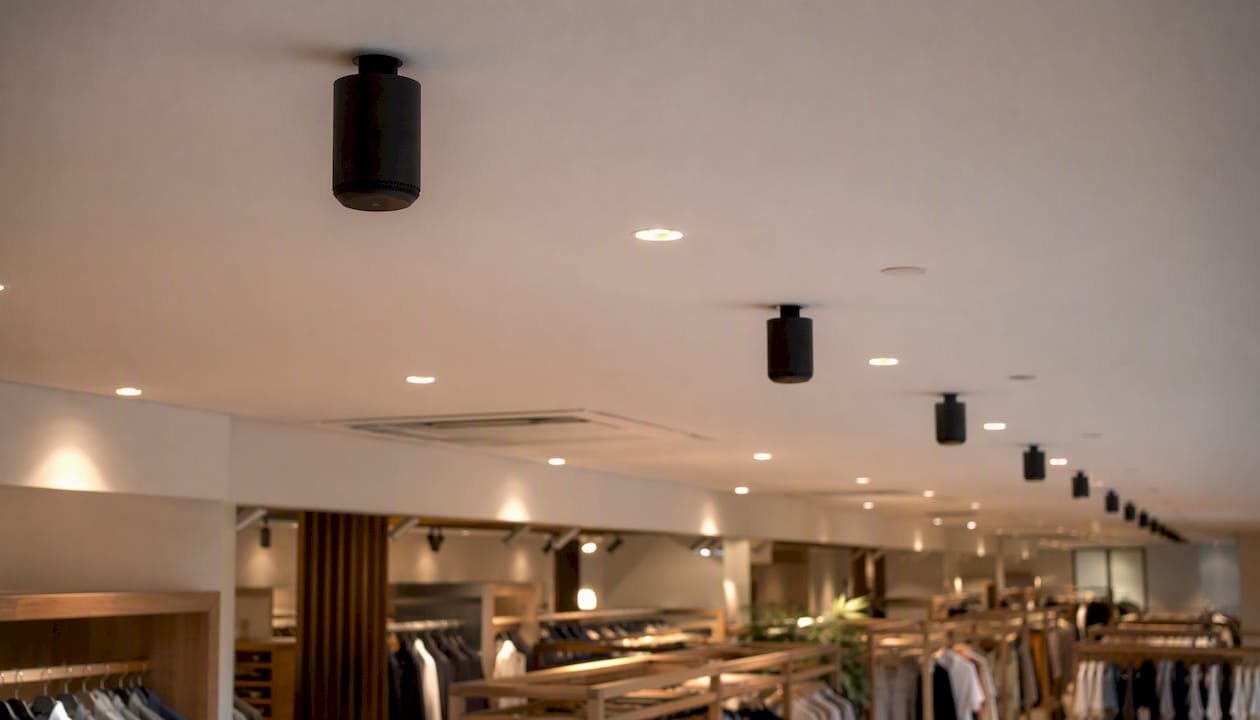
Zone your audio by function. The sales floor, fitting rooms, checkout area, and stockroom each have different acoustic needs and different customer states. A customer trying on clothes in a fitting room does not need the same volume or energy as someone browsing the main floor.
Volume and tempo reference
| Store Type | Recommended BPM | Volume Target | Notes |
|---|---|---|---|
| Luxury / boutique | 100 BPM | 65 dB | Calm, unhurried; supports conversation |
| Fast fashion / athletic | — | 70–75 dB | Energetic; matches pace of browsing |
| Grocery / convenience | — | 65–70 dB | Varies by time of day; daypart carefully |
| Café / food service | — | 65 dB | Conversational level; avoid drowning orders |
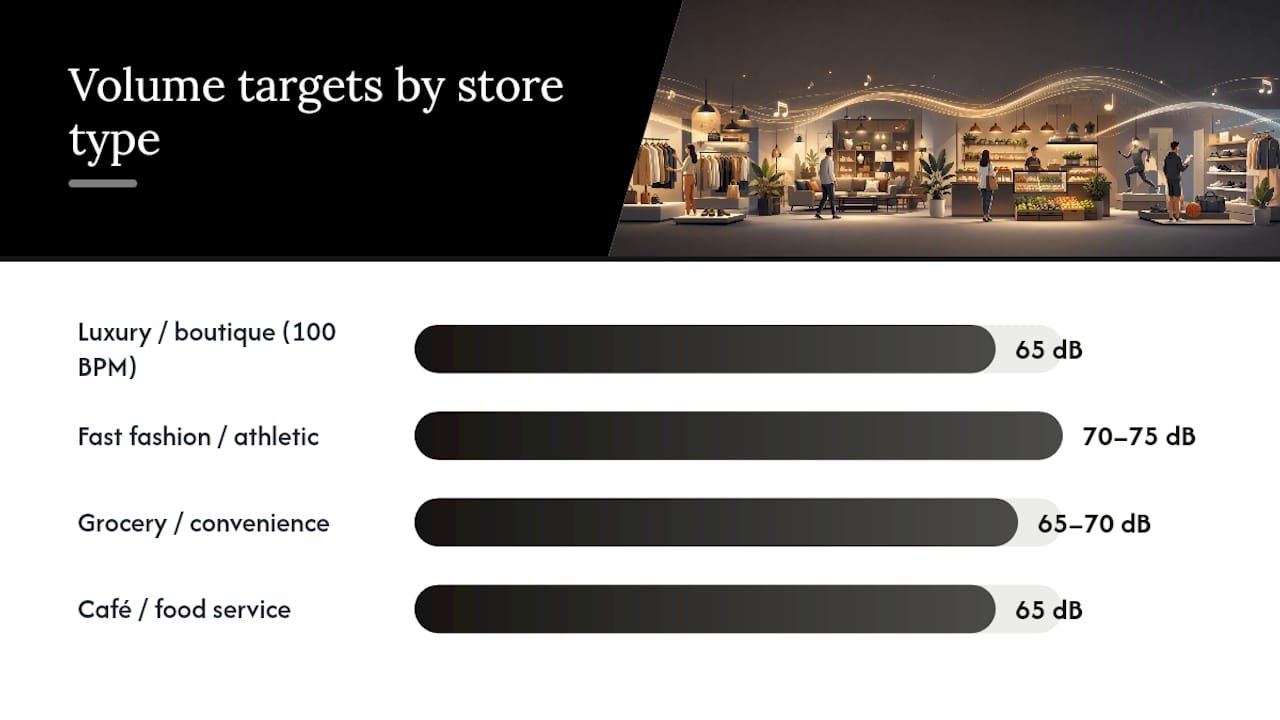
Volume at conversational level (roughly 65–70 dB) is the baseline for most retail environments. Going above 75 dB consistently shortens dwell time and increases stress, which is the opposite of what you want.
Pro Tip: For multi-location consistency, use remote monitoring to confirm actual playback volume and schedule adherence at each site. What sounds right in a flagship store may be too loud in a smaller satellite location with different acoustics.
What in-store music projects actually cost and how long they take
Expect subscription-based pricing for a managed service, with optional installation costs depending on whether you need new hardware. A realistic rollout from pilot to multi-site deployment runs 2–12 weeks.
Typical rollout timeline:
- Weeks 1–2: Pilot setup. Audio zoning plan, speaker check or installation, playlist configuration, dayparting schedule built.
- Weeks 3–6: 30-day proof of concept. KPIs tracked, promotional audio tested, staff feedback collected.
- Weeks 7–10: Iteration. Playlist adjustments, volume calibration, promo timing refined based on POC data.
- Weeks 11–12+: Scale. Additional locations onboarded using the pilot’s configuration as the template.
| Cost Driver | Notes |
|---|---|
| Licensing (multi-PRO) | Usually bundled into managed service subscription |
| Custom audio ad production | Monthly or per-campaign; varies by provider |
| Hardware (if needed) | One-time; zero-hardware cloud setups avoid this entirely |
| Multi-location management | Often tiered by number of sites |
| Annual vs. monthly billing | Annual contracts typically reduce per-month cost |
Questions to ask any vendor before signing:
- Is multi-PRO licensing included or billed separately?
- What is the production turnaround for custom in-store audio ads?
- How are schedule updates and emergency changes handled?
- Is there a minimum contract length, and what are the exit terms?
Why U.S. retailers choose a managed solution: Voraistudio as the example
A managed, commercially licensed audio solution reduces legal exposure, removes day-to-day operational overhead, and produces more consistent brand execution than any DIY approach at scale. Those three outcomes are why the category exists.
A typical Voraistudio engagement covers:
- Multi-PRO licensing (ASCAP, BMI, SESAC) handled entirely by the provider, with documentation available for audits
- Curated playlists built around the client’s brand identity, customer profile, and price point, not generic genre categories
- Dayparted scheduling with automated tempo and energy shifts keyed to traffic patterns
- Custom in-store audio ads produced monthly and inserted into the playlist at scheduled intervals
- Remote scheduling and centralized control across all locations from a single dashboard
- Ongoing content updates including seasonal overhauls and campaign-specific audio
“Voraistudio’s commitment to 100% legally licensed commercial music playback sets it apart from providers who compromise on compliance — and from retailers still relying on consumer streaming services that carry real legal risk.”
— Voraistudio
Verticals that benefit most from this model include car showrooms, restaurants, banks, salons, sports clubs, and corporate offices. The common thread is a customer-facing environment where brand consistency and compliance both matter.
Vendor evaluation checklist for U.S. retailers:
- Does the provider offer documented multi-PRO licensing coverage?
- Can you see a sample playlist before committing?
- Is dayparting included or an add-on?
- How are custom promotional audio spots produced and scheduled?
- What does the onboarding process look like for a multi-location rollout?
- Is there a pilot or proof-of-concept period before a long-term contract?
Key Takeaways
Commercially licensed, brand-fit music with scheduled dayparting is the single most effective and legally safe approach to retail background music for U.S. store owners.
| Point | Details |
|---|---|
| Licensing is non-negotiable | Consumer streaming services do not cover commercial playback; use a PRO-licensed business music service. |
| Brand-fit music drives dwell time | Brand-congruent music increases dwell time by 42.24% compared to no music at all, according to Shopify’s retail guide. |
| Daypart your schedule | Use — during peak hours and 100 BPM during off-peak periods to match customer pace. |
| Measure before you scale | Track one primary KPI for 30 days before expanding a new music setup across locations. |
| Voraistudio manages the full stack | Multi-PRO licensing, curated playlists, dayparting, custom audio ads, and remote control in one subscription. |
The part most retailers skip until it costs them
Most of the conversation around store ambiance music focuses on genre and tempo. Those matter, but the variable that consistently separates stores that see measurable lift from stores that see nothing is congruence. Not just “does this music fit the vibe” in a loose sense, but whether every element of the sonic environment, from the genre and tempo to the volume and the promotional audio style, tells the same story as the visual merchandising and the price point.
A luxury skincare brand playing aggressive EDM at 80 dB is not just making a bad music choice. It is actively contradicting its own brand promise at the moment a customer is deciding whether to trust the product enough to buy it. The music is telling them one thing; the price tag is telling them another. That cognitive friction is real, and it shows up in conversion data.
The other thing that rarely gets discussed honestly: staff fatigue is a bigger problem than customer fatigue. Customers are in your store for 10–30 minutes. Your staff is there for eight hours. A playlist that feels energetic and on-brand at 10 AM becomes genuinely demoralizing by 3 PM if it never changes. Dayparting is not just a customer experience strategy. It is a staff retention strategy. The retailers who figure this out early tend to have lower turnover in customer-facing roles, which compounds into better service quality over time.
Voraistudio handles the hard parts of in-store audio for you
Running commercially licensed, brand-fit music across one or more retail locations is not complicated when someone else manages the compliance, curation, and scheduling. That is exactly what Voraistudio delivers: a fully managed audio network with multi-PRO licensing built in, curated playlists aligned to your brand, automated dayparting, and custom in-store audio ads produced monthly.
You get centralized control across all your locations, documentation ready for any licensing audit, and a team that updates your content on a regular schedule so you never have to think about stale playlists or compliance gaps again. Car showrooms, restaurants, banks, salons, and retail chains across the U.S. use this model because it removes the legal risk and the operational overhead in one move.
To see how it works for your specific store type and location count, get in touch with Voraistudio and request a demo. The onboarding process starts with a pilot setup, so you can validate the impact before committing to a full rollout.
Useful sources for U.S. retailers
-
How To Use Music To Boost In-Store Sales: A Retailer’s Guide (2025) — Shopify: The most practical retail-specific overview available, covering tempo guidance, dayparting, brand congruence, and licensing basics. Start here.
-
Let the music play or not: The influence of background music on consumer behavior — ScienceDirect: Peer-reviewed field study with 550 participants confirming music’s effect on time and spending in store. Useful for anyone who needs academic backing for internal budget conversations.
-
The soundtrack to sales: How to select in-store music to boost customer satisfaction — Retail Customer Experience: Explains the Pleasure-Arousal-Dominance model in plain language and connects it to practical curation decisions.
-
6 Tips for Creating A Better Retail Experience with Music — Sonos Blog: Covers per-person spend data, remote monitoring, and operational tips for multi-location retailers.
-
Background Music Research: Retail Stores — Equal Strategy: Documents the most common playlist mistakes (generic selections, staff-picked music, no rotation) and how they undermine brand differentiation.
-
In-Store Audio Design | Licensed Music — Voraistudio: Overview of the managed, commercially licensed audio network model, including curation, compliance, and custom audio ad production for U.S. businesses.